


- 15 Sep 2026
- 0 Comments
- 3 Mins Read

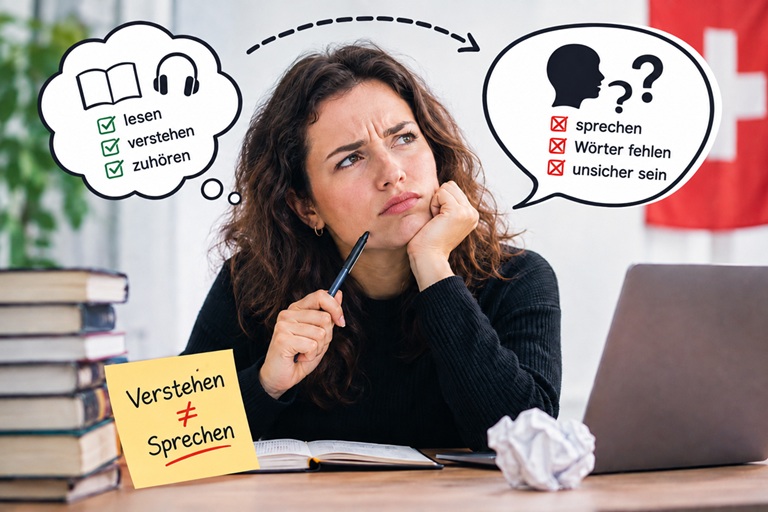
Why do I understand German, but cannot speak it?
Many learners of German know this situation: when reading or listening, they understand a lot, but as soon as they are supposed to speak themselves, the words suddenly fail them. A simple sentence takes longer than expected and the right phrasing seems to have vanished. Speaking suddenly becomes a challenge.
That is completely normal when learning a language. Because understanding and speaking are two different skills. Anyone who knows this difference can work more purposefully on actively using existing language knowledge.
Understanding and speaking are two different skills
passive and active vocabulary
The passive vocabulary includes words that we recognise and understand. In contrast, the active vocabulary encompasses words that we can use independently when speaking or writing.
For many language learners, the passive vocabulary is significantly larger. Therefore, one can easily understand a sentence even though one would have difficulty expressing the same thought spontaneously oneself.
Why words are recognised faster when listening
When listening, words, sentence structure and context are already present. You don't have to find the right word yourself, only recognise it.
When speaking, on the other hand, the brain has to select words, form sentences and use the appropriate grammar within a short space of time. This makes speaking significantly more demanding.
Why the right words suddenly go missing when speaking

Time pressure in the conversation
When reading, you can look at a sentence twice. When writing, a phrasing can be corrected. In conversation, however, the interlocutor usually expects a quick reply.
This time pressure can mean that even familiar words suddenly become difficult to recall.
Overthinking the translation
Many learners first formulate a thought in their native language and then translate it into German.
Initially, this can help. Later on, however, it often slows down the flow of speech. It is better to memorise frequently used phrases directly in German, for example:
„That depends.“
„I'm not sure.“
„In my opinion...“
Such sentence building blocks are available more quickly during a conversation.
Fear of making mistakes
Anyone who wants to check every sentence for grammar, articles, and word order before speaking will automatically become slower.
However, mistakes are part of the learning process. The important thing initially is that communication works.
Typical reasons for speech blocks

Too little active language practice
Anyone who reads a lot, watches videos and solves exercises will above all improve their comprehension of the language.
Speaking, on the other hand, is improved by speaking. Even short, regular conversations help to retrieve words and structures more quickly.
Too much focus on grammar
Grammar is important, but shouldn't have to be consciously monitored every second while speaking.
Many structures only become automatic through frequent use. Anyone who regularly uses certain sentence patterns has to think less about them later.
Learning without real conversation situations
Vocabulary lists and exercises are helpful, but real conversations are less predictable.
People speak at different speeds, change the topic or use colloquial language. Therefore, language learning should also include spontaneous communication situations.
From passive to active vocabulary
Use new words yourself
A new word is better retained if you make sentences with it yourself.
Instead of just reading a word, you should use it in different situations. This creates stronger connections in the memory.
Learn full sentences instead of individual words
Often it makes more sense to learn fixed word groups and phrase building blocks.
Instead of just learning „hang about“, you can, for example, remember:
„That depends on whether …“
Such structures make spontaneous speaking easier.
This brings more confidence to your speaking

Speak aloud regularly
Even without a conversation partner, you can practise speaking. You can describe your daily routine, explain plans or summarise a short text in your own words.
Practise everyday situations
Typical situations are particularly helpful: arranging an appointment, ordering in a restaurant, explaining a problem or introducing oneself.
The more frequently such situations are practised, the quicker suitable phrasing becomes available.
Allow for mistakes and keep talking
Fluent speaking does not mean error-free speaking. Anyone who keeps talking despite minor mistakes gains more speaking practice than someone who searches for a long time for the perfect phrasing.
When language lessons can be particularly helpful
Individual difficulties can be specifically identified in language lessons. Some learners need more vocabulary, while others need more practice in spontaneous conversations.
Role-plays, discussions and practical tasks help to use language actively and develop more fluency.
Those who understand German well, but are not yet confident in speaking it, are therefore not at the beginning. Frequently, what is simply missing is the connection between passive knowledge and active application. And precisely this connection can be trained.