



- 15 Oct 2024
- 0 Comments
- 4 Mins Read

The most important grammar rules at B2 level in French
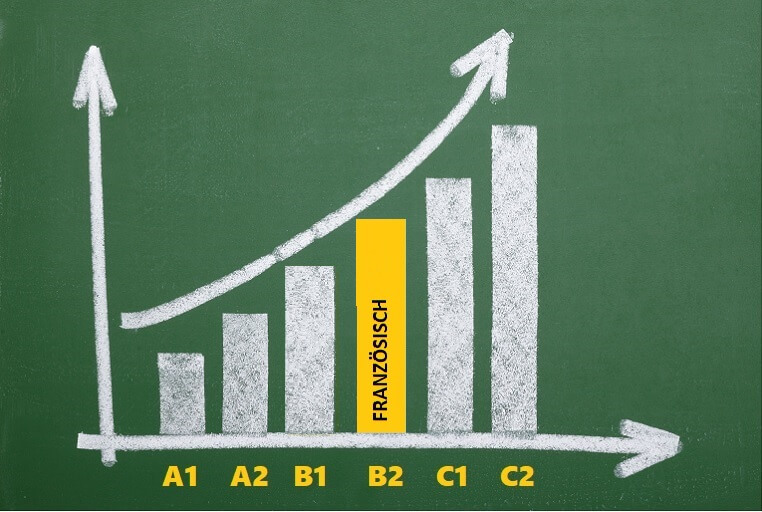
At B2 level, the French language becomes increasingly complex as you not only have to hold simple conversations, but also discuss abstract topics and understand more complicated sentence structures.
A solid command of grammar is crucial here to express yourself clearly and precisely. This post gives you an overview of the most important grammar rules at B2 level, helping you to become more confident in your use of French.
Subjunctive: When and how it is used
 The Subjunctive is one of the most striking grammatical structures in French and is often expected at B2 level. It is used to express uncertainties, wishes, doubts or emotions. Unlike the usual indicative forms, the subjunctive does not express a description of facts, but rather a possibility or necessity.
Education:
- The subjunctive is derived from the third-person plural (ils/elles) of the present tense for most verbs.
- Example: They are talking → *that I speak, that you speak, that he/she speaks…
Usage:
- Verbs like to want to, doubt that, to be afraid that require the subjunctive.
- Example: I want you to come to the party. (I’d like you to come to the party.)
Passé Composé vs Imparfait: Making the right choice
 The choice between Perfect tense and Imparfait is one of the biggest challenges for learners at B2 level. Both tenses refer to the past, but have different meanings and uses.
Past Compound:
- Used to describe completed actions or single events in the past.
- Example: Here, I’ve seen a film. (Yesterday I saw a film.)
Imparfait:
- Describes repeated actions, states, or events stretching over a longer period in the past.
- Example: When I was young, I used to play football. When I was young, I played football.
Relative clauses with „dont“ and „où“
Relative clauses are an important part of the French language at B2 level. Especially the relative pronouns don't and where are often used in more complex sentence structures.
- Don't stands for “whose” and is used when the relative clause follows a verb or noun that requires the preposition “de”.
- Example: That’s the woman I told you about. That is the woman I told you about.
- Where means „where“ or „when“ and is used to refer to places or points in time.
- Example: The day I was born… (The day I was born…)
Conditional sentences (si clauses)
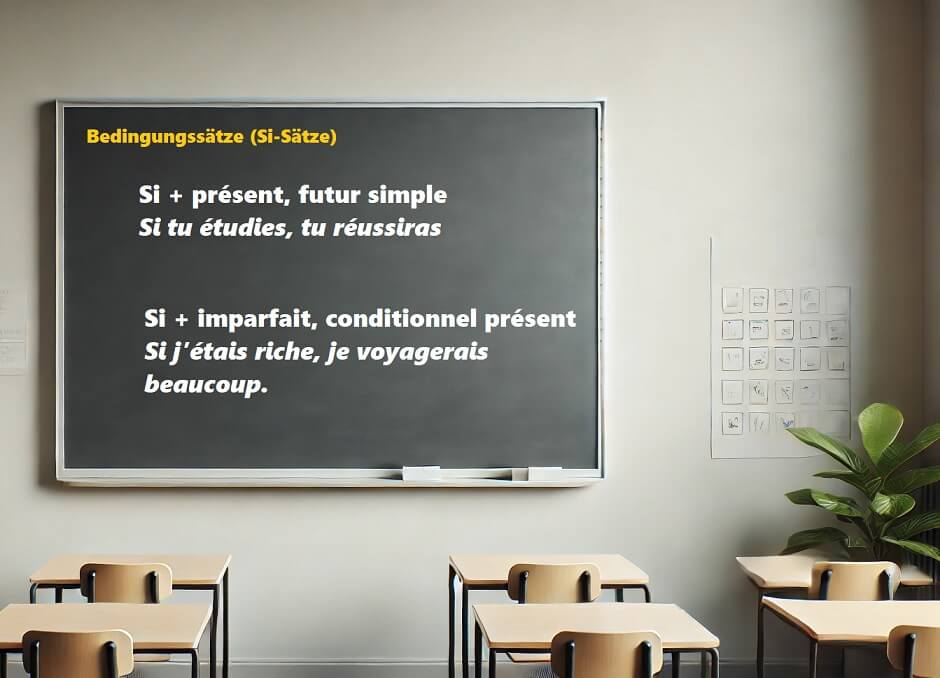 Conditional clauses, also known as „si clauses“, consist of two parts: the conditional clause (protasis) and the result clause (apodosis). At B2 level, you must master all three forms of this construction:
- Si + present tense, simple future tenseRealistic condition
- Example: If you study, you will succeed. If you study, you will succeed.
- If + past subjunctive/imperfect, present conditionalHypothetical condition
- Example: If I were rich, I would travel a lot. (If I were rich, I would travel a lot.)
- If + past perfect, conditional perfectImpossible condition in the past
- Example: If I had known, I wouldn't have come. If I had known, I wouldn't have come.
The Gérondif: An elegant way to connect sentences
The Gerund is used to describe actions that take place simultaneously or to explain means and ways.
Education:
- It is expressed by the word en + the present participle is formed.
- Example: He is driving while listening to music. He is driving while listening to music.
Usage:
- It expresses simultaneity: He was reading a book while eating. (While he was eating, he read a book.)
- Or explains how something happens: He succeeded by working hard. He was successful by working hard.
Comparison of adjectives and adverbs
At B2 level, it is important to Comparative forms to master adjectives and adverbs. The comparative and superlative are used to express comparisons.
- Comparative: more… than (more than), less than (fewer than)
- Example: She is cleverer than him. She is more intelligent than him.
- Superlative: the most… (the most)
- Example: It is the most interesting film. That is the most interesting film.
Indirect speech in French
 At reported speech requires precise knowledge of the sequence of tenses, as you often have to change the tense of the original sentence, especially when shifting the narrative tense into the past.
- Example: He says: „I am going to leave.“ → He said he was going to leave. He said that he would go.
The use of „y“ and „en“
The pronouns y and en play a major role in French, especially in spoken language.
- Y stands for „there“ or replaces expressions that begin with à Start.
- Example: Are you going to Paris? Yes, I'm going. (Are you going to Paris? Yes, I'm going there.)
- In replaces expressions with of.
- Example: Do you want some bread? Yes, I'd like some. (Would you like some bread? Yes, I would.)
Mastering B2-level grammar is crucial to your French to bring to an advanced level. Whether it is about distinguishing between the passé composé and the imparfait, the subjonctif, or the correct use of pronouns, each of these topics helps you to improve your language skills and communicate more fluently. Use these grammar points purposefully in conversations and texts to become more confident in the language and to prepare yourself for the C1 level.