



- 06 Sept 2024
- 0 Comments
- 6 Mins Read

From theory to practice: How to get your French to B1 level
In a language like French, the B1 level is a major milestone. Anyone who has put this milestone behind them has mastered the basics and can express themselves relatively confidently even in everyday situations. How do you manage the transition from theory to practice, however? After all, it is important that you can ultimately speak and understand fluently.
Here we show you how you can raise your French to B1 level and how to integrate what you have learned into your daily life.
An overview of the French B1 level
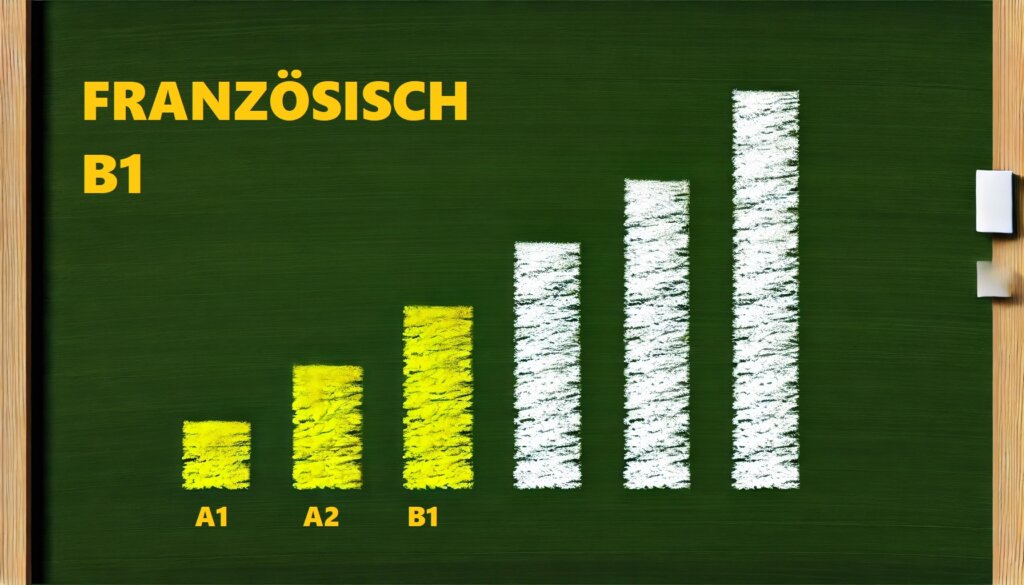 What does the B1 language level mean?
The B1 level corresponds to the intermediate level of the Common European Framework of Reference for Languages (CEFR). Once you have reached this language level, you are able to understand the main points of clear, standard communication when it is primarily about familiar topics such as work, school, leisure, etc. You can produce simple, connected texts on these topics that are familiar to you, and navigate everyday situations with ease.
What skills are expected at B1?
At B1 level, you should be able to hold basic conversations, e.g. when shopping, in a restaurant or at work. At this language level, you can describe experiences, express opinions and explain plans. It is therefore a transitional level where you can significantly improve your understanding of the language and its active use in everyday life.
Important Grammar topics for the B1 level
 Tenses: present, past and future
At the B1 level, you must have a firm grasp of the basic tenses. These occur in all everyday communication, after all. These include the present tense (Präsens), the perfect tense (Passé Composé) and the simple future tense (Futur Simple). Regularly revise how these tenses are formed and watch out for typical irregular verbs.
The use of the subjunctive
The subjonctif is a specific feature of the French language. This feature is studied in more depth at B1 level. It is used in subordinate clauses that express wishes, doubts or emotions. If you familiarise yourself with the subjonctif, you can manage to make your French sound more natural.
Relative clauses and conditional clauses
Relative clauses allow you to link sentences together and make your statements more precise. Conditional clauses are also important at B1 level, as they enable you to express hypotheses and possible consequences. These grammatical structures are essential because they allow you to express more complex ideas.
Vocabulary building at B1 level
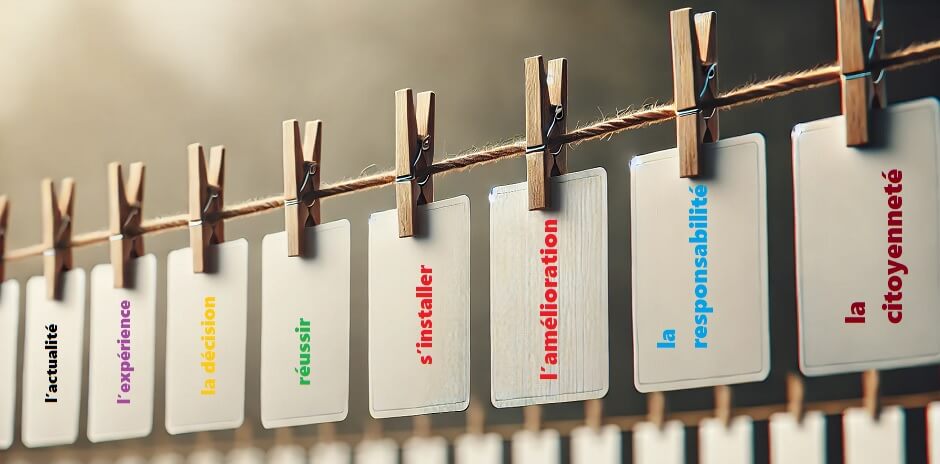 Subject areas such as travel, work, everyday life: At B1 level, you should have a solid foundation of vocabulary covering everyday topics. This means that, as well as individual words, you should also learn the relevant phrases. Topics such as travel, everyday working life and hobbies are particularly important. You can use apps to expand your vocabulary in these areas in a targeted way.
 - Useful phrases for everyday life: As well as individual words, commonly used idioms and set phrases are, of course, also important. Phrases such as „Ça va?“, „Je voudrais…“ or „C’est super!“ are used all the time in everyday conversation. These will help you to communicate more fluently and with greater confidence.
- Vocabulary apps and learning techniques: Apps are excellent tools for expanding your vocabulary to B1 level. Set yourself daily goals and revise regularly. Use flashcards or digital tools to help you memorise new words more effectively.
Improvement of listening and reading comprehension
 Below, I’d like to share with you some tried-and-tested strategies that can help you improve your listening and reading comprehension in the long term.
- French podcasts and news: One effective way to improve your listening comprehension is definitely to listen to French podcasts or news programmes. Start by choosing content designed for learners, and gradually work your way up to authentic French media such as „Le Monde“ or „France Inter“.
- French books and articles at B1 level:Reading is another important way to practise if you want to improve your command of the language. Start with simple books designed for language learners at B1 level. Short stories or articles on topics that interest you are perfect for significantly improving your vocabulary and reading skills.
- Understanding films and TV series in French: If you watch films or TV series in French, start by using subtitles in your native language and switch to French subtitles later on. This will help you understand the spoken language better whilst learning new words in context.
Speaking at B1 level
In the following sections, I’d like to explain how you can build your self-confidence through regular practice and, step by step, become a confident French speaker.
- Conversation exercises for everyday life: Practise having conversations in French. You can do this by speaking to native speakers whenever you get the chance, or by signing up to language exchange platforms such as Tandem. Start with short, everyday conversations and work your way up to more complex topics.
- Find language exchange partners and tandem programmes: A language partner helps you to practise speaking French regularly. With a tandem programme, you can swap languages with a native speaker: you help them with your native language, whilst they help you with French in return. It’s a win-win situation!
- Overcoming speech inhibitions: Language learners are often afraid of making mistakes. But mistakes are all part of the process! Have the confidence to speak, even if it’s not perfect. The more you speak, the more confident you’ll become in French.
Practical exercises for everyday life
In the following section, I’d like to explain how you can effectively simulate everyday communication situations so that you can conduct yourself with confidence in both your personal and professional lives.
- Practising everyday French conversation: Practise everyday conversations by going through French language scenarios in your head. Whether you’re out shopping, in a restaurant or travelling, the more often you repeat typical phrases, the more naturally you’ll be able to use them.
- Simulating shopping and travel situations: Imagine you’re on holiday in France: what questions would you ask? Practise placing simple orders in a café or asking for directions. That way, you’ll be prepared for real-life situations.
- Communication in the workplace: If you need French for work, it is helpful to practise typical conversations from everyday working life. Learn how to write emails, make phone calls or give presentations.
Useful resources and apps for French B1
- The best apps for learning vocabulary: Some useful apps include Anki, Quizlet and Memrise. You can use them to create personalised vocabulary lists and revise them regularly.
- Interactive exercises and websites: Websites such as „Français Authentique“ or „BBC Languages“ offer interactive exercises. These help you to improve your grammar and listening comprehension to B1 level.
- Online courses and platforms for self-directed learning: Platforms like Coursera or edX offer free and paid French courses that specifically support you up to B1 level.
French courses in Basel
In Basel, the language school SLA Basel a wide range of French courses at A2 level and other levels, which adapt to different learning styles and schedules. These include Intensive French courses, Semi-intensive courses as well as Evening classes for those who only have time in the evening.
Besides these group classes, there is also the possibility in the One-to-one tuition to tailor the learning pace individually. French courses are also available online. So whoever Learn French online wants, has the opportunity to take part in individual lessons from home.
For learners preparing for official French language certificates would like to prepare, SLA Basel also offers special Preparation courses . In addition, there is also French courses for professional purposes, to prepare specifically for the requirements of the working environment. Anyone wishing to learn French therefore has plenty of opportunities at this language school.
How to prepare for the transition to B2
 What is the difference between B1 and B2?
The main difference between B1 and B2 lies in the degree of independence. Whilst at B1 you can hold basic conversations, at B2 you will be able to express yourself fluently and spontaneously on more complex topics.
Tips for making the leap to the advanced level
To make the transition to B2, it is important to practise continuously. Set yourself clear learning goals, expand your vocabulary and regularly challenge yourself with new grammar topics.