


- 29 Jul 2026
- 0 Comments
- 3 Mins Read

English language course or tutoring: What is better for my child?
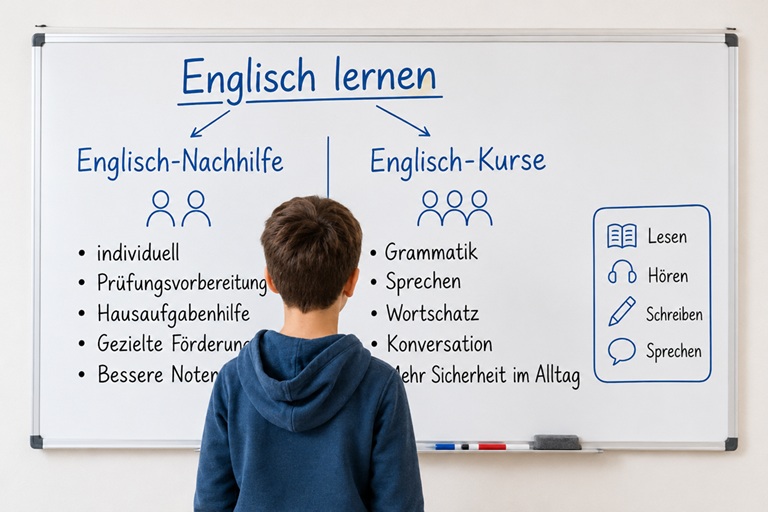
If a child is having difficulties in English lessons or wants to further improve their language skills, parents are often faced with the question: Is traditional English tutoring more useful, or is an English language course better suited? Both options can be helpful, but they pursue different goals. Therefore, the deciding factor is what kind of support the child actually needs.
What is English tutoring?
English tutoring generally focuses on the school curriculum. The main emphasis is on current topics from the textbook, homework, grammar rules, vocabulary and exam preparation.
Tutoring is particularly suitable when a child:
- poor or significantly fluctuating grades has,
- does not understand certain grammar topics,
- has fallen behind with schoolwork,
- Help with homework needed,
- needs to prepare specifically for an exam.
The main goal is to close existing knowledge gaps and improve academic performance. Lessons are therefore often tailored to the curriculum and the requirements of the respective school.
What does an English language course offer?
An English language course usually takes a more comprehensive approach. As well as grammar and vocabulary, it also focuses on listening comprehension, reading, writing and, in particular, speaking.
Children learn English not just as a school subject, but as a language they can use in everyday life. Depending on their age, the lessons incorporate pictures, songs, games, creative tasks, dialogues and role-plays. Older pupils also work with texts, conversations and real-life communication situations.
An English language course is particularly suitable if a child:
- wants to speak more confidently and fluently,
- wants to improve their pronunciation,
- to develop a joy of language,
- wishes to prepare for a trip or a stay abroad,
- wishes to develop his knowledge in the long term,
- wants to learn beyond the school curriculum.
The main differences
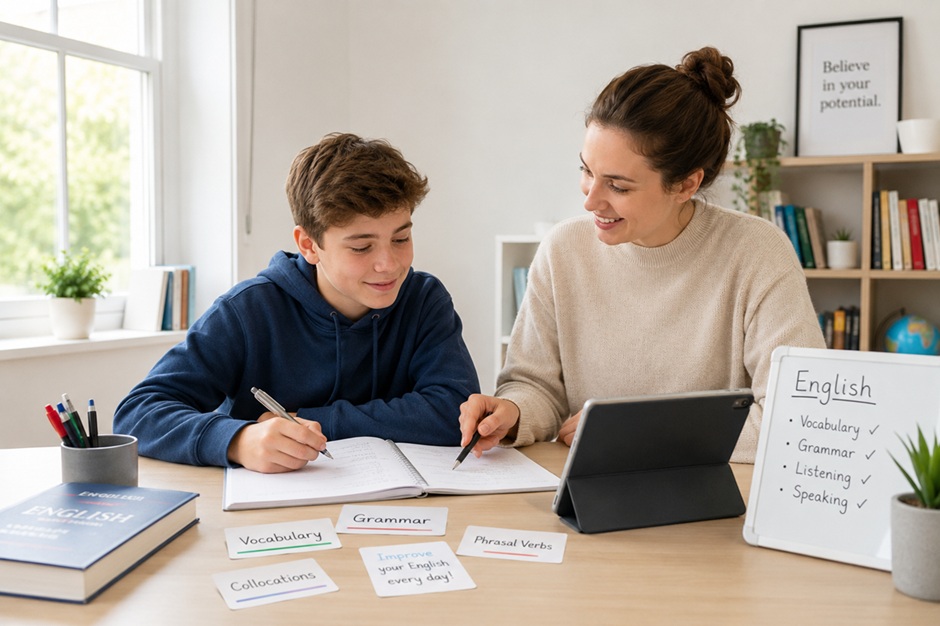
The biggest difference lies in the learning objective. Tutoring usually responds to a specific school problem. A language course, on the other hand, builds general language proficiency.
In private tuition, for example, the focus is on an upcoming exam, a difficult grammar topic or a specific chapter from the textbook. In a language course, on the other hand, various skills are combined. The aim is for the child to be able to understand English, apply it and use it increasingly independently.
The teaching methods also differ. Tutoring is often more explanation- and task-oriented. Language courses usually work in a more communicative way and place more emphasis on active speaking.
When is private tuition the better option?
Private tuition is useful when there is an urgent need for action. If, for example, a child is struggling with tenses, sentence structure or vocabulary tests, targeted support can quickly ease the pressure.
Tutoring can also help before exams or when moving up to a higher year group. It is important that not only are tasks solved, but fundamental problems with understanding are also identified.
When is an English language course a better option?
A language course is a good choice if the child generally copes well with the schoolwork but is unsure about speaking or would like to learn English more intensively.
Children who are particularly shy benefit from using the language without the pressure of school marks. Regular conversations, age-appropriate exercises and positive learning experiences can boost their self-confidence.
Language courses also offer suitable opportunities for development for children who start at an early age or who already have a good knowledge of the language. Depending on what is on offer, courses can range from beginner to advanced level.
One-to-one lessons or group lessons?
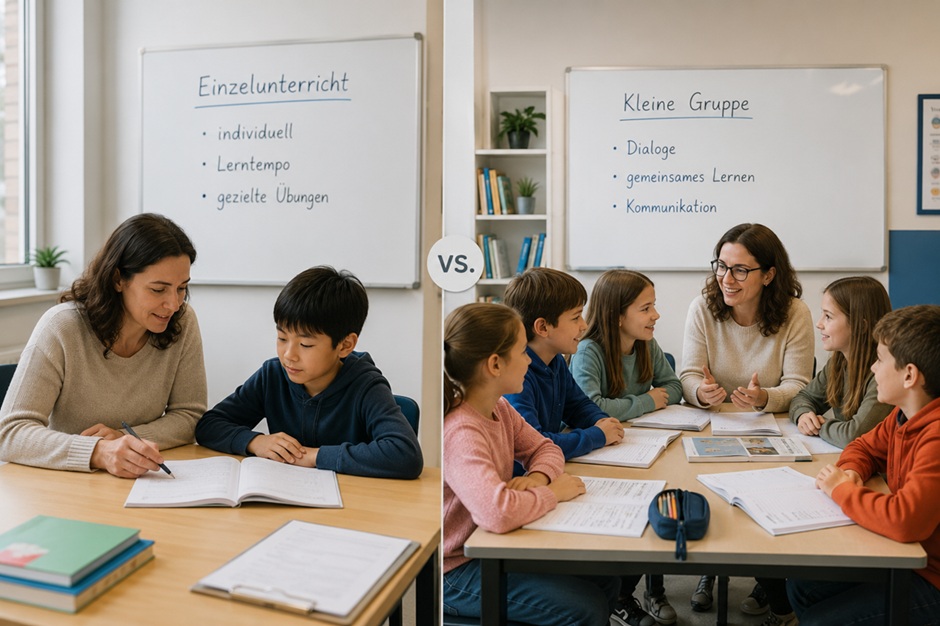
One-to-one lessons allow for a highly personalised approach. The teacher can tailor the pace of learning, the content and the exercises precisely to the child’s needs. This approach is suitable both for addressing specific gaps in knowledge and for achieving personal language goals.
Small groups, on the other hand, offer more opportunities for dialogue and collaborative learning. Children can talk to one another, learn from one another and practise their communication skills.
Which approach is best depends on the child’s personality, age and learning objectives.
Can the two offers be combined?
Tutoring and language courses are not mutually exclusive. For example, a child might receive temporary tutoring to catch up on any gaps in their schoolwork, and at the same time or afterwards attend an English language course to improve their spoken English.
Individualised support in the English language course
A language course can also be useful if a child needs to fill specific gaps in their school education. In the case of English courses for teenagers and children from SLA Basel Not only are vocabulary, grammar and sentence structures consolidated, but conversation, listening and reading comprehension, writing and speaking are also practised.
One-to-one lessons are tailored to your individual level and specific goals, and you can start at any time at levels A1 to C1. Flexible course days and lesson times also make it easy to fit the course in alongside school and leisure activities.
English tuition is therefore particularly useful where there are specific difficulties at school. An English language course is better suited to building up comprehensive language skills over the long term. Parents should therefore not focus solely on school marks, but also take into account how confidently their child understands, speaks and uses English. The best solution is the one that suits the child’s level of learning, their goals and their personality.