


- 29 Jul 2026
- 0 Comments
- 3 Mins Read

Which English language certificate is right for me: Cambridge, IELTS or TOEIC?
Why an English language certificate can be useful
A English language certificate documents your language skills clearly and can be beneficial for job applications, further training, or university admissions. Especially with international companies and educational institutions, a recognised certificate is often an important selection criterion. Which English language certificate is suitable, but depends heavily on your personal goal.
Which goals you should clarify before selection
First, consider what you need the certificate for. Do you want to advance your career, start vocational training, or apply to a university abroad? It is also crucial whether general, academic, or professional English skills are to be tested. Furthermore, take into account the required language proficiency level and the deadline by which you need to submit the result.
Cambridge Certificates: FCE and CAE at a Glance
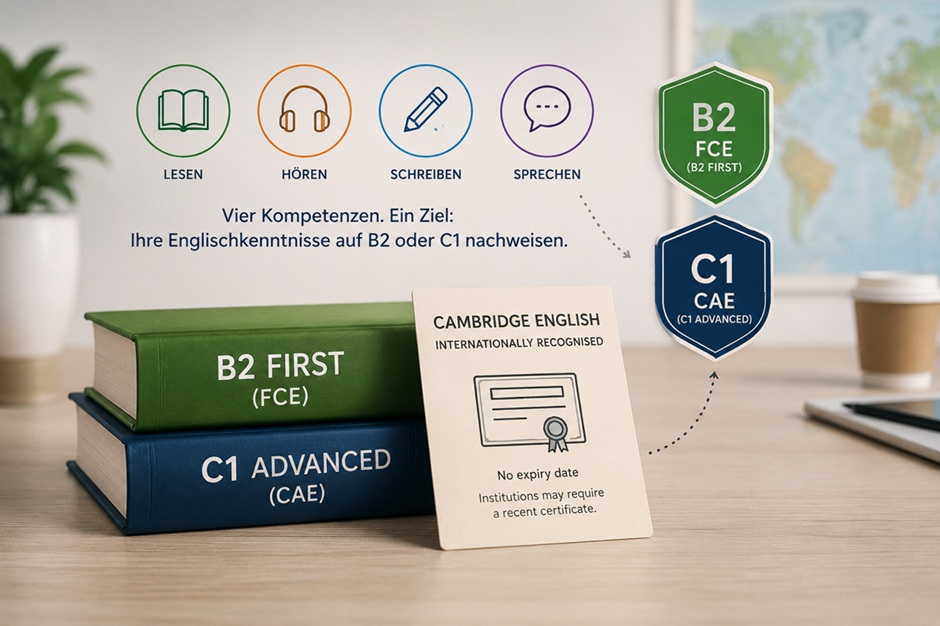
Cambridge English qualifications They assess reading, listening, writing and speaking, and are based on the Common European Framework of Reference for Languages. The B2 First, formerly known as the FCE, certifies independent proficiency in English at B2 level. The C1 Advanced, also known as the CAE, is aimed at advanced learners.
Such a English language certificate is particularly suitable for individuals who want to demonstrate their general language proficiency in the long term. Cambridge certificates themselves generally do not have a set expiry date. However, institutions may require that the language proof is not too old.
IELTS: English test for study and international goals
IELTS assesses the four skills of listening, reading, writing, and speaking on a scale from 0 to 9. IELTS Academic is primarily intended for study and academic purposes. IELTS General Training focuses more on everyday life, work, and emigration.
This English language certificates is accepted by numerous universities and public authorities. IELTS results are generally used as proof of current proficiency for a limited period. The IELTS test It is therefore particularly suitable if you are planning to apply to a university, apply for a visa or organise a stay abroad in the near future.
TOEIC: English language skills for the workplace and professional life
The TOEIC focuses on English in professional situations. TOEIC Listening and Reading tests listening and reading comprehension, while TOEIC Speaking and Writing assesses active language use.
As work-related English language certificate The TOEIC can be useful when applying for jobs or within companies operating internationally. It is particularly suitable for people who wish to demonstrate their communication skills in a day-to-day work context.
Cambridge, IELTS or TOEIC: The main differences
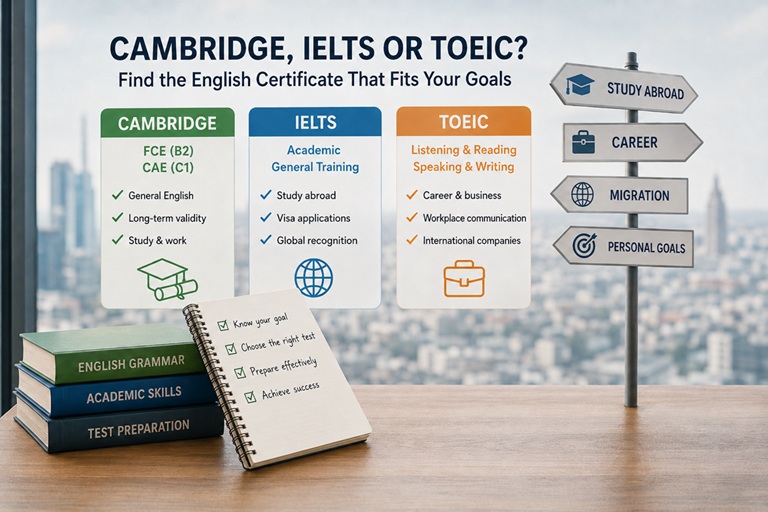
Cambridge assesses comprehensive general language proficiency at a specific level. IELTS is particularly geared towards academic, international and migration-related goals. TOEIC, on the other hand, focuses on the working world.
The assessment also differs: Cambridge exams refer to set proficiency levels, IELTS uses a band system, and TOEIC uses a points scale. Therefore, a English language certificate should be selected not solely on the basis of their popularity, but according to their intended area of application.
Which certificate is right for which goal?
For school and general language proficiency, Cambridge B2 First or C1 Advanced are often useful. IELTS Academic is frequently required for studying abroad. TOEIC can be suitable for international companies. Those looking for a long-term proof often choose a Cambridge certificate. For emigration or visa procedures, you should check which English language certificate is accepted by the competent authority.
What level of language proficiency do you need?
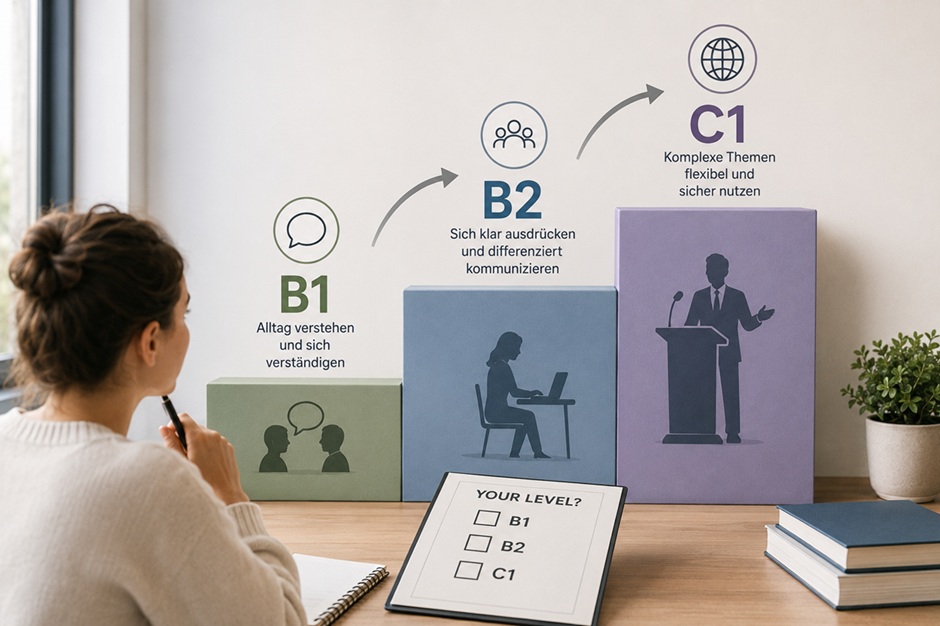
Levels B1, B2 and C1 describe different degrees of linguistic autonomy. At B1, you can cope with many everyday situations. B2 enables significantly more nuanced communication, whilst C1 requires flexible and sophisticated language use.
One Classification before exam preparation shows which English language certificate is realistically achievable. An exam level that is too high can cause unnecessary pressure, while a level that is too low may not meet the requirements.
How to prepare purposefully for the exam
Get to know the exam format early on and practise all the relevant skills. In addition, grammar and vocabulary should be systematically expanded. Practice tests help to improve time management and familiarise yourself with typical tasks. It is particularly important to identify individual learning gaps and work on them in a targeted manner.
Benefits of a certificate course with one-to-one tuition
In one-to-one tuition, preparation can be tailored precisely to your exam goal, your learning pace and your current level. Individual exam sections can be practiced more intensively, while regular feedback highlights specific areas for improvement. Flexible dates and an individual course start make planning easier. This is how you prepare in a structured way for the desired English language certificate before.