



- 30 Sept 2025
- 0 Comments
- 4 Mins Read

German for everyday life: Idioms that everyone needs
Why idioms are so important
Anyone wanting to learn German quickly realises one thing: words and grammar alone are not enough if you really want to be understood in everyday life. We must not forget that native speakers constantly use set expressions that often cannot be translated literally.
These idioms bring conversations to life and ensure that your German sounds more natural and fluent. For example, if someone says „That’s a weight off my mind“, it is not about real stones, but about the feeling of relief. Such figures of speech are typical of the German language. Exactly these are the ones you should know if you want to use German in everyday life.
Idioms for small talk and encounters
Small talk is one of the most important situations when learning German. Whether in a café, at work or in the neighbourhood, with a few typical phrases it is much easier to start a conversation.
- „How are things?“ is the classic question that always fits.
- „Alright?“ is informal, among friends or acquaintances.
- „See you soon! or See you later!“ shows warmth and friendliness.
👉 Tip: Listen carefully to how native speakers use such sentences, and try to imitate them directly. This trains pronunciation and linguistic intuition.
Idioms about food and drink

Switzerland is known for its food culture, from a shared breakfast to dinner with friends. Here too, there are set idioms that help us, German in everyday life to use actively. Let's look at some examples:
- „Enjoy your meal!“Enjoy your meal.
- „I'm as hungry as a hunter.“To be extremely hungry.
- „That's not my cup of tea.“ That's none of my business.
👉 Practical idea: When you are in a restaurant, you can consciously use such expressions. Your dining companion will immediately notice that you are culturally „in the game“.
Idioms in the working day
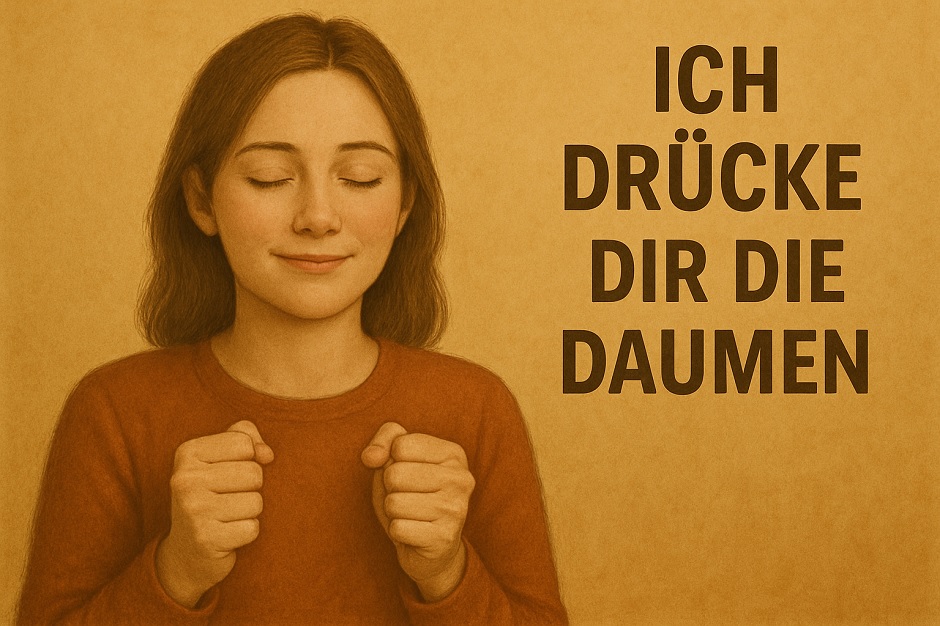
Especially those who need to learn German for work or studies benefit from typical Business idioms. These idioms sound professional and make communication within the team easier.
- „I've got everything crossed for you.“This is how you wish someone success.
- „To juggle everything“That describes the challenge of coordinating various tasks, interests or appointments.
- „That is not my remit.“How to set boundaries politely.
👉 Language school tip: In many German exams (e.g. telc or Goethe) exactly such expressions appear. It is therefore worth practising these idioms early on.
Shopping & errands: Typical idioms
Anyone shopping in a supermarket, at a market or in a shop is constantly confronted with short polite phrases. It is worth learning and using the following and others:
- „What can I get you?“Standard question at the baker's or butcher's.
- „That is a real bargain.“ means very cheap.
- „Could you please help me?“This is how you make a polite enquiry in a shop.
👉 Study tip: Write down typical situations for yourself (e.g. at the supermarket) and practice memorising the appropriate phrases. After just a short time, you will feel much more confident.
Expressing feelings and situations

Learning languages also means conveying emotions correctly. Germans use many common phrases to express joy, annoyance or relief. Let's look at the following examples:
- „That's a load off my mind.“ brings a huge sense of relief.
- „I've had enough.“You can use this to express annoyance and anger.
- „Everything is tickety-boo.“ let me know if everything is alright.
👉 Practical exercise: Try to describe a situation every day using an idiom. This not only trains your vocabulary, but also your expressiveness.
Understanding cultural proverbs

Many German idioms come from fairy tales, literature, or folk culture. They are often quoted, even if they are not meant literally.
- „All's well that ends well.“Happy ending.
- „The early bird catches the worm.“The early bird catches the worm.
- „Practice makes perfect.“Regular practice makes you better.
👉 Note: Such proverbs are in German exams popular. They show that you know cultural contexts.
Learn German in Basel
Do you want to speak fluent German and thereby actively participate in your life in Switzerland? At the language school SLA Basel there are language courses for every German level and learning pace for you. Get advice from us so that you Learn German in Basel can. Our partners include, among others, Tutor Academy.
Tips for learning and applying idioms
- Practising dialogues: Roleplay everyday conversations (e.g. shopping, restaurant visits).
- Writing flashcards: One side with idiom, back with explanation.
- Using apps: Many language-learning apps offer specific idioms.
- Speaking with native speakers: Ask which expressions they use particularly often.
👉 Language school advantage: In a Language course in Basel or online course you learn idioms in realistic situations – exactly that makes the difference to self-learning.
The key to lively and authentic German
Idioms are therefore the spice of any language. They make conversations lively, demonstrate cultural knowledge, and help to avoid misunderstandings. If you really want to experience German, idioms are a must.
Whether in everyday life, at work or in an exam, with the right idioms you instantly sound more authentic and confident. Practise regularly, try out new expressions and make mistakes. That way, you will become more fluent step by step.