


- 1 May 2026
- 0 Comments
- 5 Mins Read

Learning German as a French person in Basel: Tips for a successful start
As a Frenchman in Basel lives, works or studies, quickly realises that knowledge of German makes everyday life much easier. Although Basel is an international city where many people understand English or French, German nevertheless plays a central role in many areas.
For French-speaking learners, German initially often feels unfamiliar. The pronunciation sounds harsher, the grammar appears more structured and the word order differs significantly from French. At the same time, there are many ways to learn German step by step and apply it directly in everyday life.
Why German is particularly important for French people in Basel
As a Frenchman in Basel, you might be able to get by with French in certain situations, especially because of the proximity to the French border. However, anyone wanting to stay in Basel long-term needs a solid knowledge of German. They help with official appointments and building personal contacts.
Knowledge of German is also an advantage in professional life. Many employers expect at least basic knowledge, especially when communicating with customers, colleagues or local institutions. In everyday life, too, you feel more secure when you understand conversations and can actively respond yourself.
Typical challenges for French-speaking learners
French and German differ in many respects. One of the biggest challenges is the German articles: der, die and das. Although French also has grammatical genders, they do not always match those in German. Therefore, it is best to always learn German nouns directly with their article.
Cases are also difficult for many learners. Accusative and dative change articles, pronouns and sometimes adjectives as well. Whilst in French sentence structure is often regulated more via prepositions, German shows many relationships within the sentence through cases. As someone who French people in Basel learning German should practice these basics early on so that later topics are easier to understand.
Pronunciation: Umlaute, „ch“ and German word stress
German pronunciation is particularly interesting for French-speaking learners. Sounds like „ü“, „ö“ or „ch“ do not exist in the same form in French. German word stress can also be unusual, as it often feels stronger and clearer than in French.
It is important to focus on clear pronunciation early on. It is not about speaking completely without an accent. The crucial thing is that you are easily understood. Regular repetition, listening exercises and corrections in class help to gain confidence.
Word order: Why German works differently
Another important point is German word order. In the main clause, the conjugated verb is usually in the second position: „Ich lerne Deutsch.“ In subordinate clauses, however, the verb often stands at the end: „Ich lerne Deutsch, weil ich in Basel arbeite.“
For French-speaking learners, that can be unusual at first. In French, the sentence structure usually remains more stable. In German, you have to pay closer attention to whether it is a main clause, subordinate clause or a question. As French people in Basel you benefit from not only learning typical sentence patterns theoretically, but also speaking them aloud regularly.
False friends between German and French
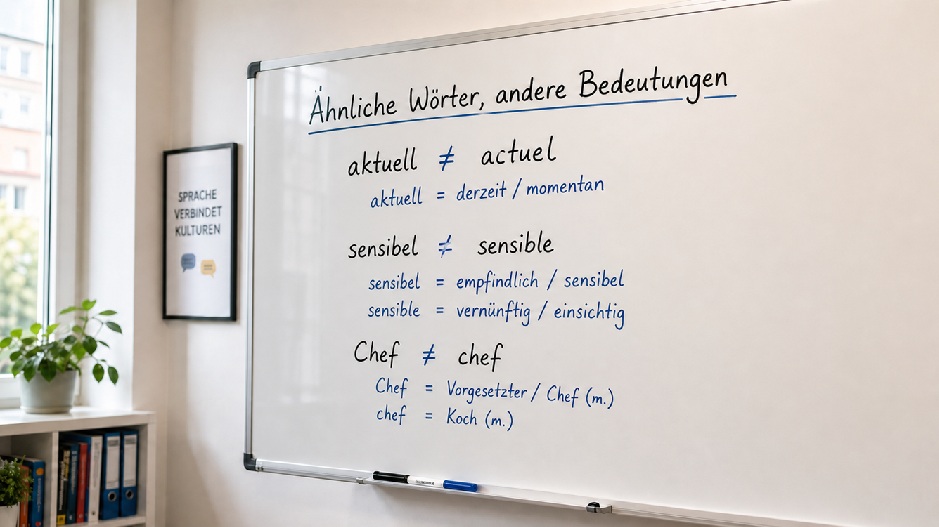
There are also words between German and French that look or sound similar, but do not always mean the same thing. Such false friends can quickly lead to misunderstandings. An example is „aktuell“. In German, this does not mean „actuel“ in the sense of „current“ in every situation, but is often used to mean „currently“ or „at the moment“.
Terms in a professional or official context should also be learned precisely. Especially with forms, contracts or official appointments, it is important not just to understand words vaguely. Anyone who learns German in a targeted way avoids such uncertainties more quickly.
Standard German and Swiss German: What you should know
In Basel, you often hear Swiss German or the Basel dialect in everyday life. For learners, this can be confusing at first because the dialect sounds different from the High German taught in class. Nevertheless, High German is the right foundation. It is written, taught and used in many official situations.
Therefore, one should not be discouraged if one does not immediately understand conversations on the street or on the tram. This is normal even for many advanced learners. First, one should build up a secure command of Standard German. After that, one can slowly get used to Swiss German.
Practical study tips outside of class

You don't learn German just in class. Small daily habits are very effective. You can set your mobile phone to German, write short messages in German, listen to simple German podcasts or consciously read German terms while shopping.
Even short conversations in everyday life help. It is enough to start with simple sentences. The important thing is to practise regularly and not to see mistakes as a problem. Mistakes are a natural part of learning and show that you are actively using the language.
Why a German course in Basel is particularly helpful
A German course offers a clear structure, personal correction and regular motivation. French-speaking learners in particular benefit when differences between German and French are specifically explained. This makes it easier to understand why certain mistakes occur.
Furthermore, a course offers the opportunity to speak German in a safe environment. You can ask questions, repeat things and practise typical everyday situations. For every Frenchman in Basell, who wants to speak German more confidently, a professional course can therefore be an important step.
At SLA Basel French-speaking learners can work specifically on improving their German language skills step by step. The courses combine grammar, vocabulary, pronunciation and practical communication, enabling what has been learned to be applied directly in everyday life. The structured teaching is particularly helpful in this regard: learners receive clear explanations, regular exercises and personal feedback.
In this way, the German course becomes not just a theoretical learning module, but a practical resource for everyday life, work and social interactions in Basel.
Speak German more confidently in Basel
Learning German therefore requires patience, but with the right method, significant progress is possible. Regular speaking, clear grammar foundations, practical exercises and the courage to use the language in everyday life are particularly important.