


- 1 May 2026
- 0 Comments
- 6 Mins Read

Learning German in Basel as an English speaker
Learn German in Basel is often an important step for English speakers to feel more confident in daily life, at work and in social settings. Basel is characterised by its international, open and multilingual atmosphere. Many people speak English, especially in academic, economic and cultural fields. Nevertheless, German remains the central language for many everyday situations.
Why German often seems easier for English speakers than it is
German and English both belong to the Germanic languages. That is why many words look familiar at first glance. Terms like „Haus“ and „house“, „Mutter“ and „mother“ or „Wasser“ and „water“ show that there are linguistic connections. That can make getting started easier.
At the same time, this closeness sometimes leads to a false sense of security. German has a significantly stronger grammatical structure than modern English. Articles change, nouns have a grammatical gender, verbs do not always stay in the same place, and the cases influence the sentence structure. Anyone wanting to learn German in Basel should understand these differences early on.
Typical pitfalls: articles, cases and word order
One of the biggest challenges are the articles „der“, „die“ and „das“. In English there is only „the“. In German, however, you have to know which grammatical gender a noun has. On top of that come the cases: nominative, accusative, dative and genitive. They determine which form the article or pronoun takes in the sentence.
Word order is also unfamiliar for English speakers. Especially in subordinate clauses, the conjugated verb often stands at the end. „I know that he is coming“ becomes in German: „Ich weiss, dass er kommt.“ Such structures feel alien at first, but with regular training they become increasingly natural. Anyone who tackles learning German in Basel purposefully should therefore not only collect vocabulary, but also actively practise sentence patterns.
False Friends: words that quickly lead to misunderstandings
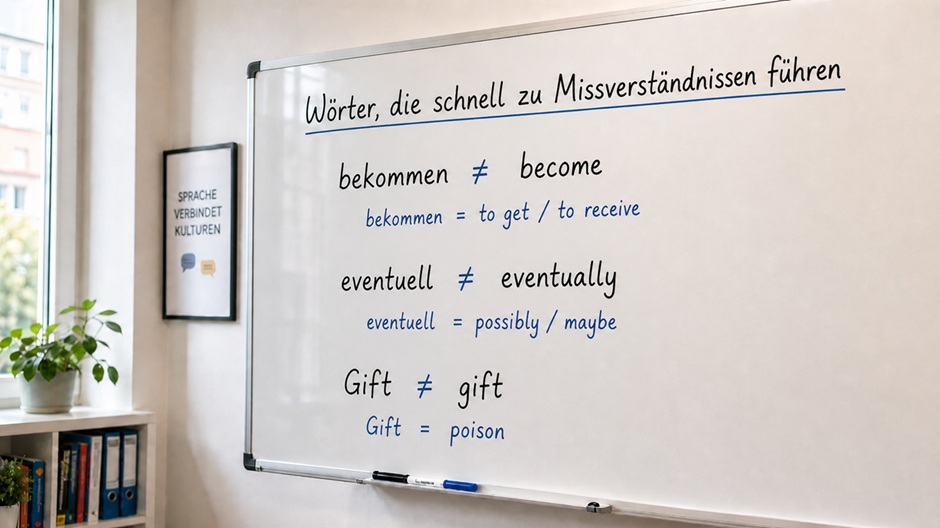
False friends are words that look or sound similar in two languages, but mean something different. For English speakers, this can quickly lead to misunderstandings in German. A well-known example is „bekommen“. It does not mean „to become“, but „to get“ or „to receive“. „Ich bekomme ein Geschenk“ therefore means: „I receive a gift.“
Even „eventuell“ does not necessarily mean „eventually“, but rather „possibly“ or „maybe“. The German word „Gift“ does not mean „gift“, but „poison“. Such words should be learned consciously, as they can quickly lead to false statements in everyday life and at work.
Pronunciation training: Umlaute, „ch“ and German stress
German pronunciation presents English speakers with particular challenges. Umlauts such as „ä“, „ö“ and „ü“ do not exist in the same form in English. The „ch“ sound in words such as „ich“, „nicht“ or „Buch“ is also unfamiliar to many learners. Furthermore, German words are often pronounced more clearly and precisely than English ones.
Another point to bear in mind is stress. In German, the stress often falls on the first syllable, but not always. With compound words, you need to recognise which part is particularly important. Regular repetition, listening exercises and feedback from teachers help to improve your pronunciation step by step.
Key situations and phrases
In everyday life, you need German in lots of little situations: when shopping, at the doctor’s, when looking for a flat, when chatting to neighbours, at school, on the phone or at appointments. It is precisely these situations that show that language skills are not just about grammar and vocabulary. You also need to know the right way to say things.
Phrases such as: „I’d like …“, „Could you please repeat that?“, „I’d like to make an appointment“ or „Could you please help me?“ are useful. Such phrases give you confidence and can be used in many situations.
Standard German, Swiss German and the Basel dialect: What learners should know
For many English speakers, the language situation in Basel comes as a surprise at first. Standard German is usually used in classes, official texts and formal situations. In everyday life, however, you often hear Swiss German or the Basel dialect. This can be confusing at first, as the pronunciation, choice of words and rhythm sound different.
Nevertheless, Standard German is the right foundation for learners. It is the language used in writing, in the classroom and in many official contexts. You can learn to understand Swiss German step by step as you go along. It is important not to be discouraged if conversations on the street or on the tram are difficult to understand at first.
Practising speaking German: How English speakers can overcome their inhibitions
Many English-speaking learners understand German before they are able to speak it actively. This is often because they are afraid of making mistakes or quickly switch back to English in everyday situations. It is precisely this habit that can slow down their progress.
You learn to speak by speaking. Mistakes are not a sign of weakness in the process, but a natural part of learning. Short conversations in everyday life, partner exercises in class and regular repetition help to break down inhibitions. It is particularly useful to practise fixed situations in German: introducing yourself, asking the way, making an appointment or talking about your job.
German for Work and Everyday Life: Which language goals are particularly important
The appropriate language goals depend heavily on personal circumstances. Anyone who needs German for their career should set different priorities than someone who mainly wants to become more confident in everyday life. In the professional sphere, emails, telephone conversations, meetings, technical terms and polite formulations are particularly important.
In everyday life, however, the focus is on practical matters: shopping, health, family, housing, school, leisure and dealing with the authorities. A good language course, such as, for example, German Professional Language or German Courses for Companies It combines both areas and adapts the content to the learners’ level. This creates a clear learning path that is not merely theoretical, but can be applied directly.
Why a German course in Basel can be particularly helpful
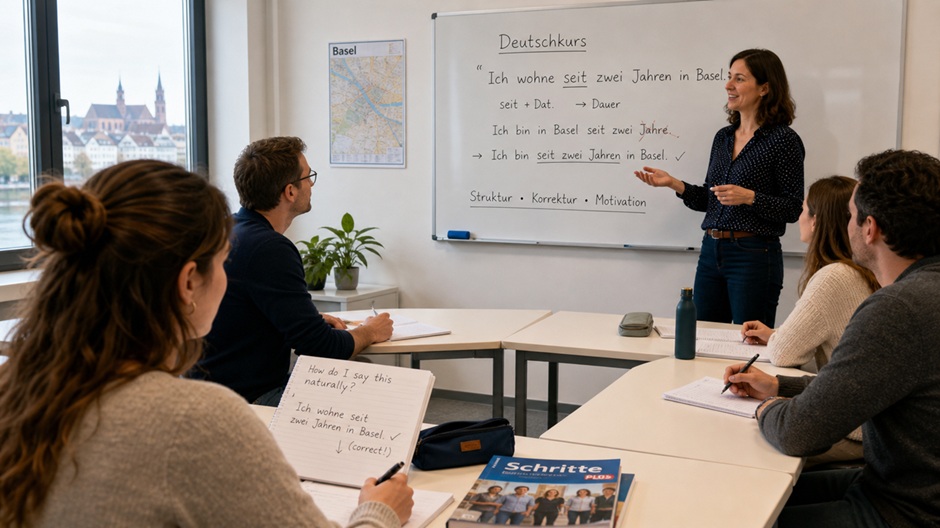
A German course provides structure, feedback and motivation. English speakers in particular benefit when common mistakes are explained and corrected straight away. Teachers can show why a sentence sounds wrong, which grammar rule is involved, and how to express it more naturally.
Moreover, a course creates a fixed learning routine. You speak with others, practise realistic situations and get feedback. This is particularly valuable if you could easily switch to English in everyday life. Those who Learn German in Basel When combined with professional support, it helps build confidence more quickly and avoids typical learning barriers.
At SLA Basel English-speaking learners can work specifically on improving their German language skills step by step. The courses combine grammar, vocabulary, pronunciation and practical communication so that what has been learned can be applied directly in everyday life. The structured lessons are particularly helpful: learners receive clear explanations, regular exercises and personal feedback.
In this way, the German course becomes not just a theoretical learning module, but a practical resource for everyday life, work and social interactions in Basel.
Speaking German more confidently with the right method
German may therefore seem familiar to English speakers at first, but it quickly becomes challenging due to articles, cases, word order and pronunciation. With the right approach, however, these challenges can be easily overcome. The key lies in structure, regular practice, practical application and the courage to make mistakes.
Basel offers the ideal environment for this: international enough to make it easier to get started, and German-speaking enough to use the language on a daily basis. Anyone who Learn German in Basel Anyone who sees this as a long-term, practical process can gradually gain more confidence in their everyday life, at work and in their social life.