



- 25 May 2026
- 0 Comments
- 8 Mins Read

Politeness in different languages: What one should know
Politeness is an important part of any communication. It shows respect, attention and consideration towards other people. However, what sounds polite in one language can seem cold, exaggerated or even rude in another. Anyone learning a foreign language should therefore not only know words and grammar, but also understand how politeness works in that language.
For language is always culture too. Greetings, forms of address, requests, apologies and basic conversational rules say a great deal about how people interact with one another.
What does politeness mean in communication?
Politeness does not mean the same thing everywhere. In some cultures, it is considered polite to speak very directly and clearly. In other cultures, it is expected that wishes, criticism or rejection are formulated carefully and indirectly.
A simple example:
If someone in German says, „Ich brauche Ihre Unterlagen bis morgen“, it can come across as factual and professional. In another language, however, the same direct statement might sound severe or unfriendly. There, a softer phrasing might be more common, such as: „Wäre es möglich, mir die Unterlagen bis morgen zu schicken?“
Politeness therefore depends heavily on the expectations a speech community has regarding good behaviour.
Direct and indirect communication
A major difference between languages lies in directness. In German, clarity is often valued. People state comparatively clearly what they want, what they expect or what is not working. That does not automatically mean that the person is being rude. Often it is simply about precision and efficiency.
In English, on the other hand, people often use more indirect phrasing. Particularly in a professional context, sentences often sound friendlier and more cautious. Instead of „Send me the file“, you’re more likely to hear: „Could you please send me the file?“ or „Would you mind sending me the file?“
Indirect communication also plays a major role in many Asian languages. A clear „no“ may be perceived as too harsh. Instead, expressions are used that imply refusal in a more subtle way.
Forms of address: ‘du’, ‘Sie’ and other levels of politeness
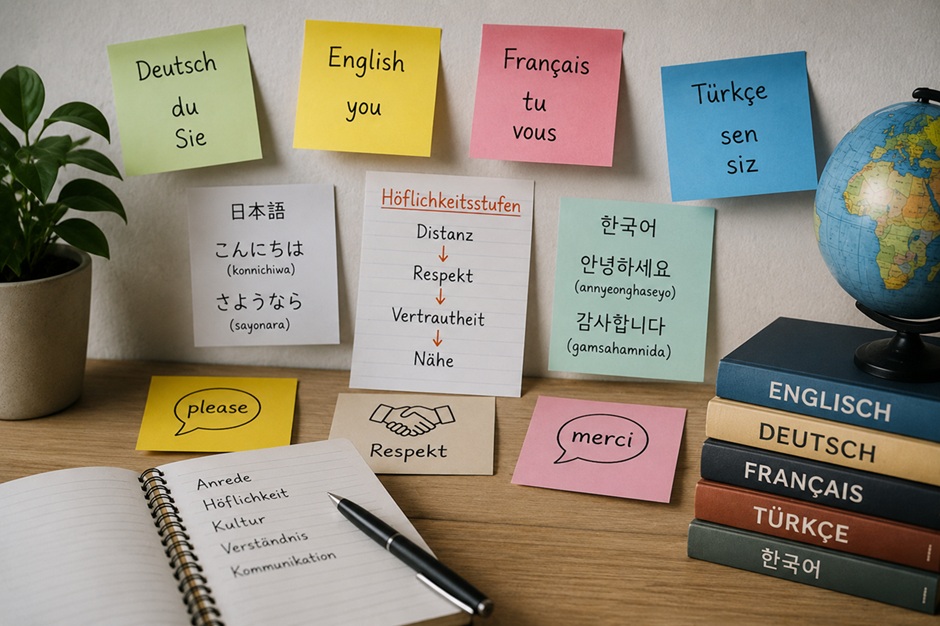
Forms of address are a key element of politeness. In German, there is a distinction between „du“ and „Sie“. „Sie“ conveys distance, respect or professionalism. „Du“ comes across as more personal, familiar and informal.
In other languages, the system is different. In English today, there is only „you“. Nevertheless, this does not mean that English has no forms of politeness. Politeness is expressed more through tone, sentence structure and words such as „please“, „sorry“, „would“ or „could“.
In French, as in German, there is a distinction between „tu“ and „vous“. If you use „tu“ too soon, you may come across as rude or overly familiar. In Turkish, too, there is a similar distinction between „sen“ and „siz“. „Siz“ is used when you want to show respect or maintain a certain distance.
In languages such as Japanese or Korean, levels of politeness are even more complex. In these languages, the way you speak changes depending on who you are talking to: older people, superiors, customers, friends or family members.
Please, thank you and sorry: small words with a big impact
Words such as „please“, „thank you“ and „sorry“ may seem small, but they are very important. They show that you respect the other person and value their time or help.
However, there are differences here too. In German, „bitte“ is often used, but not in every sentence. In English, „please“ is very important in many situations to ensure that a request does not sound like a command.
In Turkish, expressions of gratitude and formulas of respect also play an important role. Words like „teşekkür ederim“, „sağ olun“ or „rica ederim“ are very prevalent in everyday life. Expressions shaped by religion or culture can also be part of polite communication.
In Arabic, greetings and polite formulas are often more elaborate. People don't just briefly ask „How are you?“, but show interest, respect and connection through several formulas.
Politeness in German
The German language is sometimes perceived as direct or austere. This is partly because many statements are phrased clearly and objectively. In German, it is often more important to be unambiguous than to use flowery language.
Nevertheless, there are many ways to phrase things politely. Modal verbs and tactful expressions are particularly important:
„"Could you please help me?"“
„"Would you be so kind as to send me the documents?"“
„"May I ask you something quickly?"“
„Excuse me, would you have a moment?“
In German, politeness often means: using respectful forms of address, clear wording, an appropriate tone and consideration for the situation.
Politeness in English
In English, good manners are often closely linked to the use of indirect language. In the UK in particular, requests, criticism or wishes are frequently expressed very cautiously.
A direct phrase such as „Give me your number“ can quickly come across as rude. A friendlier way of asking would be: „Could I have your number, please?“ or „Would you mind giving me your number?“
Criticism is also often softened in English. Instead of saying „This is wrong“, people tend to say: „I’m not sure this is quite right“ or „Perhaps we could look at this again.“
This can sometimes be unfamiliar to learners, as the actual message may be hidden behind a lot of polite phrasing.
Politeness in French
In French, style plays a major role. Using the correct form of address, a polite opening and appropriate phrasing are particularly important. In formal situations, you use „vous“, not „tu“.
Greetings are also very important. Anyone who enters a shop in France without saying „Bonjour“ can quickly come across as rude. In France, treating people with respect often begins even before the actual conversation takes place.
Typical polite expressions include:
„Bonjour, Madam / Sir“
„Please“
„Merci beaucoup“
„Excusez-moi“
„Je vous en prie“
French courtesy is very much rooted in etiquette, respect and linguistic subtlety.
Politeness in Turkish
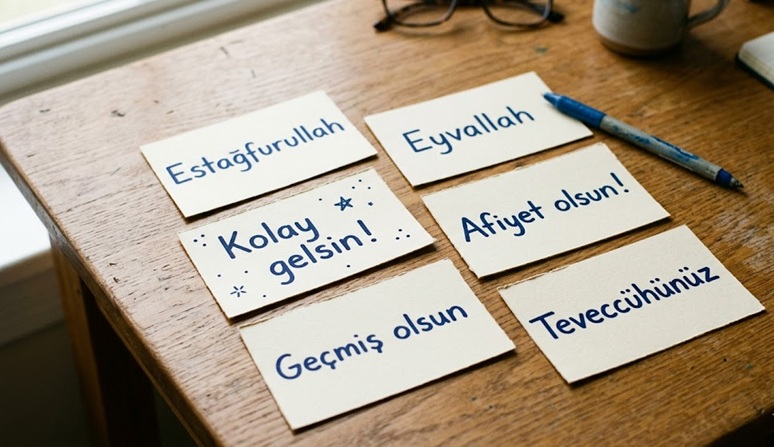
In Turkish, politeness is closely linked to respect, warmth and social closeness. It is particularly important to use respectful forms of address when speaking to older people, guests or figures of authority.
The polite form „siz“ is used when one wishes to express a sense of distance or respect. There are also many cultural forms of politeness that are very common in everyday life.
Examples include:
„Buyurun“
„Teşekkür ederim“
„Thank you“
„May the work go easily for you“
„Get well soon“
„Enjoy your meal“
Interestingly, many of these expressions are situational. For example, „Kolay gelsin“ is said to people who are currently working. „Geçmiş olsun“ is used in cases of illness, problems, or unpleasant situations. Such expressions show that politeness consists not only of grammar, but also of social empathy.
Politeness in Arabic
In Arabic languages and dialects, greetings, respect and hospitality play a very large role. Conversations often begin with several friendly questions and good wishes.
Tact is shown not just through individual words, but through an entire conversational attitude. One takes time, asks after one's well-being and uses respectful expressions.
Even religiously influenced formulas can be part of everyday language. They express gratitude, hope, respect, or good wishes. Depending on the country and dialect, however, these forms differ significantly.
For learners, it is important to note that Arab sensitivity often comes across as warmer, more detailed and more personal than in many European languages.
Politeness in Japanese and Korean
Japanese and Korean show particularly clearly how closely language and social hierarchy can be connected. The way one speaks depends heavily on whether the other person is older, has a higher status, or what kind of relationship one has with them.
In Japanese, there are various levels of politeness. A distinction is made, amongst other things, between neutral, polite and very respectful language. In Korean, too, verb forms and sentence endings change depending on who you are speaking to.
For people learning such languages, it is therefore not enough just to know vocabulary. One must also know which form is appropriate in which situation.
Typical misunderstandings between different languages
Many misunderstandings arise not because of incorrect grammar, but because of differing expectations regarding politeness.
A German person can come across as too direct in English.
An English person may come across as unclear or awkward in German.
A French person may attach great importance to a formal greeting.
A Turkish person can expect a special warmth and personal attention.
A Japanese person may avoid giving a direct refusal, whilst a German person expects a clear answer.
Such differences can easily lead to false impressions. You might think, „That person is unfriendly“, even though they are simply communicating according to the rules of their own language.
Why direct translations can often come across as impolite
A common mistake when learning a language is to translate directly from one’s mother tongue. However, politeness cannot always be conveyed word for word.
A sentence can be grammatically correct and still sound impolite. This happens particularly with requests, refusals, complaints or criticism.
For example, a direct request may be perfectly normal in one’s native language, but come across as harsh in another language. That is why one should not just ask, „Is this sentence correct?“, but also, „Does this sentence sound natural and polite?“
This is exactly where a genuine feel for language begins.
Tips for polite communication in a foreign language
If you want to speak politely in a foreign language, you should pay attention to more than just individual words.
Above all, it is important to learn typical formulations. Fixed phrases for greetings, requests, thanks, apologies and polite refusals are particularly helpful.
It’s also worth observing how native speakers talk in everyday situations: in shops, at work, in emails, on the phone or at formal meetings. This helps you recognise which turns of phrase really sound natural.
The tone you use makes a big difference too. A grammatically simple sentence can come across as polite if it is said in a friendly manner. Conversely, a linguistically correct sentence can sound unfriendly if the tone and the situation do not match.
Politeness means understanding language and culture together
Anyone who really wants to master a language should therefore not just learn grammar and vocabulary. It is just as important to understand the cultural norms behind the language.
Language learning actually has many facets: it is also about understanding cultural nuances, forms of politeness, typical idioms and the appropriate tone in different situations.
That is precisely why good language courses are so important. Professionally structured English courses in Basel, German courses in Basel, French courses in Basel Or courses in other languages help learners to experience language not in isolation, but in a lively and practical way, as part of everyday life.
Anyone who learns a language in the right context can communicate with greater confidence, avoid misunderstandings and express themselves more effectively in personal, professional and intercultural situations.